Across the park
The Trains
"I suppose I've always been in love with trains." — Walt Disney (Walt Disney Family Museum)
Of all the ideas that passed through the plans for Disneyland, only one never changed. In every version, a train ran around the edge of the park. Everything else in this chapter, from the miniature mine trains to the Monorail, grew out of that one fixed point.
A railroad in the backyard
As a boy in Missouri, Walt wanted to be a locomotive engineer like his father's cousin Mike Martin, who drove trains on the Santa Fe and told stories about it. As a teenager, Walt sold newspapers, candy and cigars to passengers on the Missouri Pacific. Years later, after polo injuries left him with damaged vertebrae, his doctor told him to find a calmer hobby. In late 1947 he bought some Lionel train sets (Wikipedia: Disneyland Railroad).
The hobby did not stay small. In 1949, building a new family home in Holmby Hills, Walt laid a ridable miniature railroad behind it and called it the Carolwood Pacific. Its locomotive, the Lilly Belle, was named for Lillian. The studio machine shop under Roger Broggie built it at one-eighth scale from the blueprints of a Central Pacific engine of 1872, and it first ran on May 7, 1950. On weekends, visitors rode, and some were allowed to drive. In early 1953 one of them took a curve too fast. The train derailed and a five-year-old girl was hurt. Walt shut the railroad down and put the Lilly Belle in storage.
The Santa Fe & Disneyland Railroad
By then the backyard line had already started turning into something bigger. On August 8, 1953, Walt drew the railroad's route onto the site plan for Anaheim. Broggie's machine shop scaled up the Lilly Belle design, and the final size was set after Walt admired some narrow-gauge passenger cars from Hawaii that had just arrived at the Travel Town museum in Griffith Park. Walt owned the railroad personally, through WED, and named both trains Retlaw, which is Walter spelled backward.
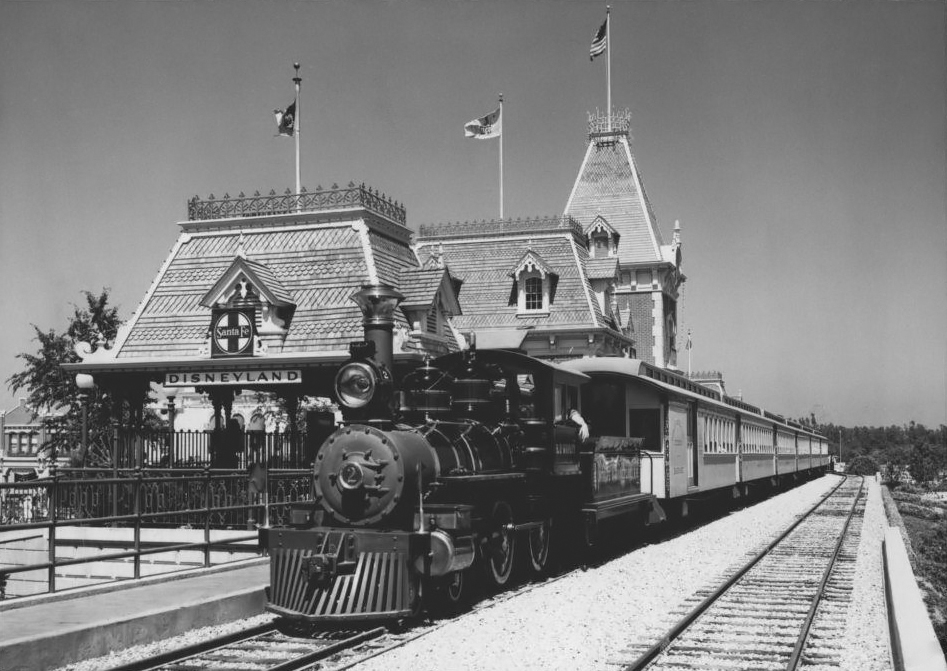
The first two trains told a small story. The E. P. Ripley pulled a passenger train of 1890s coaches. The C. K. Holliday pulled a freight train of cattle cars and gondolas. Ward Kimball raised concerns about safety, but Walt insisted the cattle cars have no seats, so passengers would ride like cattle on a real cattle train. A crew under Joe Fowler built the roundhouse in a week. On July 10, 1955, a train ran the full loop for the first time. The railroad was the first attraction in the park to work.
On opening morning, Walt drove the Ripley into Main Street Station himself. In the cab with him were California governor Goodwin Knight and Santa Fe Railway president Fred Gurley, and Art Linkletter and Ronald Reagan were waiting on the platform. The Santa Fe paid $50,000 a year to put its name on the line, and kept it there until September 30, 1974.
Within a week there was a wreck. A brakeman threw a switch too soon as the freight train passed the passenger train at Main Street Station, and the caboose swung sideways into a concrete slab and came off the rails. No one was hurt. In the commotion, the brakeman walked out of the park and was never seen there again.
The five engines
As crowds grew, the railroad needed more engines. Rather than build new ones, Broggie went looking for old ones. All five still belong to the line (Wikipedia: Disneyland Railroad; D23).
| No. | Name | Built | In service | Story |
|---|---|---|---|---|
| 1 | C. K. Holliday | 1955, WED | July 17, 1955 | Modeled on Walt's Lilly Belle; named for the Santa Fe's founder |
| 2 | E. P. Ripley | 1955, WED | July 17, 1955 | Walt's favorite; named for the Santa Fe's first president |
| 3 | Fred Gurley | 1894, Baldwin | March 28, 1958 | Once switched cars at a Louisiana sugar mill; the oldest of the five |
| 4 | Ernest S. Marsh | 1925, Baldwin | July 25, 1959 | Bought for $2,000 from a New Jersey tourist line; first shipped to Pittsburgh by mistake |
| 5 | Ward Kimball | 1902, Baldwin | June 25, 2005 | Hauled Louisiana sugar cane as the Maud L.; the first engine named for a Disney artist, not a railroad man |
Scenery along the line
In 1958 the train gained a show. On March 31, the Fred Gurley pulled the first train into the Grand Canyon Diorama, a tunnel lined with a single painted canvas 306 feet long and 34 feet high, set to Ferde Grofé's Grand Canyon Suite. A 96-year-old Hopi leader, Chief Nevangnewa, blessed it at the dedication. In 1966 the Primeval World followed next door, with dinosaurs that had first performed at the 1964–65 New York World's Fair. It was among the last things added to the park before Walt died that December.
In 1975 one of the original 1955 coaches was rebuilt as a parlor car, paneled in mahogany and hung with Disney family photographs, and named the Lilly Belle. Its first official passenger, that September, was Emperor Hirohito of Japan.
Thirty years later the line carried a guest of a different kind. On a morning in May 2005, before the park opened, the director John Lasseter brought his own small steam engine, the Marie E., to New Orleans Square Station. It had once belonged to Ollie Johnston, one of the animators who first got Walt interested in trains. Johnston, then in his nineties, was helped into the cab, and with Lasseter beside him he drove it three times around the park.
Stations, then and now
The railroad opened with two stops, Main Street and Frontierland. Fantasyland got a depot in 1956, removed in 1966 to make room for "it's a small world," and Tomorrowland got one in 1958. The Frontierland stop kept its name even after New Orleans Square grew up around it, until 1996. A Videopolis station of 1985 became Mickey's Toontown Depot in 1993. From January 2016 to July 29, 2017, the trains stood still while Star Wars: Galaxy's Edge was built. They came back on a new route past waterfalls and a trestle, with the line's only left-hand turn. When the Mark Twain passes on the river, the two blow their whistles at each other in the rhythm of "Shave and a Haircut." The line is 1.2 miles long and carries an estimated 6.6 million riders a year.
The Viewliner, 1957–1958
Not every train in Disneyland looked backward. When a circus tent was cleared from the area near Fantasyland, Walt asked Bob Gurr for something quick and cheap to fill the space. Gurr built two streamlined trains, scaled-down copies of General Motors' Aerotrain, each powered by an Oldsmobile V8. The cars of the Tomorrowland train were named for the planets and those of the Fantasyland train for Disney characters. Disney billed it as the fastest miniature train in the world (Walt Disney Family Museum). It closed on September 15, 1958, to clear ground for the Matterhorn and the submarines, making it one of the shortest-lived rides in the park's history. Sources differ on its opening date, June 10 or June 26, 1957.
Mine trains of Frontierland
On July 2, 1956, the Rainbow Caverns Mine Train began carrying guests through a painted desert of balancing rocks and glowing underground pools. In 1960 Walt asked the animator Marc Davis to put more humor into the park, and on June 12 the ride reopened as the Mine Train Through Nature's Wonderland. It held more than two hundred animal figures, with narration by Dallas McKennon. It ran until January 2, 1977 (Wikipedia). Its replacement, Big Thunder Mountain Railroad, opened on September 15, 1979, and still loads passengers in the mining town of Rainbow Ridge from the old ride. One surviving mine-train locomotive is being restored by Garner Holt Productions, with work expected to finish in early 2027.
Casey Jr. Circus Train
The little circus train from Dumbo ran on opening day, closed the next morning for safety testing, and reopened on July 31, 1955 (Wikipedia). It still circles the miniatures of Storybook Land on two-foot-gauge track.
The Monorail
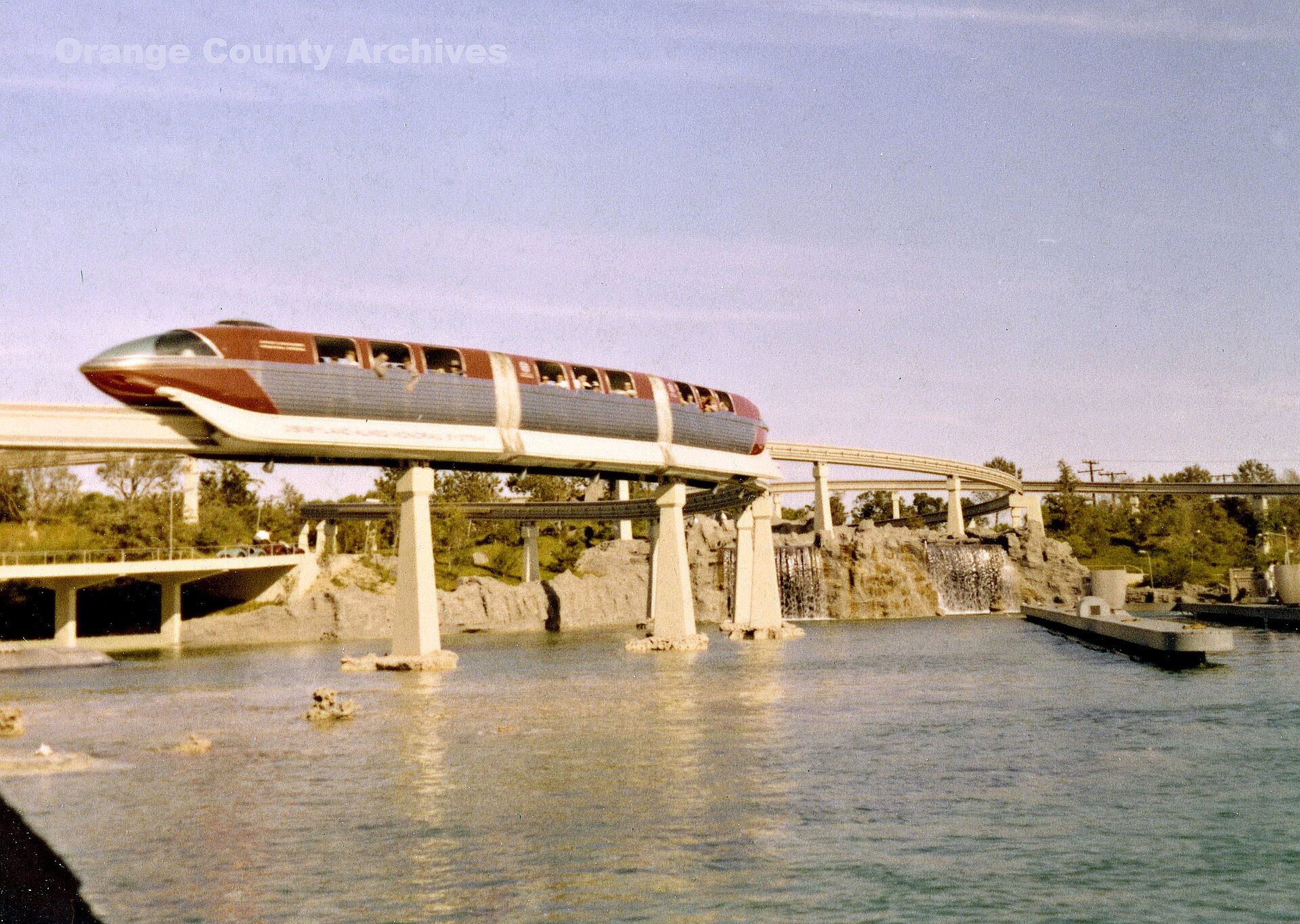
On June 14, 1959, Walt brought the future to Tomorrowland: the Disneyland-Alweg Monorail, the first daily-operating monorail in the country. Bob Gurr's team built it at the Burbank studio with help from Alweg, the German firm that pioneered the design. Walt hoped American cities would adopt it as public transit (Wikipedia: Disneyland Monorail). At the televised dedication, the Nixon daughters' ribbon would not cut, and Walt stepped in.
In 1961 the beam was extended about two and a half miles to a second station at the Disneyland Hotel, turning a ride into real transportation. The trains have been rebuilt four times since: Mark II in 1961, Mark III in 1969, Mark V in 1987, and the current Mark VII, which entered service in 2008 and 2009. Today's three trains are Red, Blue and Orange.
Horsecars and trolleys
On Main Street, horse-drawn streetcars have run on three-foot-gauge rails since 1955. Across the esplanade, Disney California Adventure ran the Red Car Trolley, modeled on Los Angeles's Pacific Electric cars, from its debut in 2012 until February 8, 2025, when it closed to make way for the Avengers Campus expansion. Guests lined up for hours for a last ride. The final run of the night went to Mickey, Minnie and the trolley's own crew (WDWNT).
Fun facts: the trains
- Walt's favorite car on the line was the combine car of the original passenger train, which reminded him of his days selling newspapers on the Missouri Pacific. It is now displayed beside his Carolwood Barn in Griffith Park (Wikipedia: Disneyland Railroad).
- Each engine uses about 75 gallons of water for one trip around the park. Together they burn about 200,000 gallons of fuel a year.
- Since 2009, the engines have run on biodiesel that includes recycled cooking oil.
- At the old Frontierland depot, a recorded telegraph taps out the opening of Walt's dedication in Morse code.
- Guests can ask at Main Street Station to ride up front in the tender, or in the Lilly Belle parlor car when a cast member is free to host it.
- A different engine named Ward Kimball was bought first, in 1996. It proved too big for Disneyland, went to Walt Disney World, and was traded to Cedar Point for the 1902 Maud L., which became today's No. 5.
- The headlamp of the Ward Kimball carries gold-leaf silhouettes of Jiminy Cricket, the character Kimball animated.
- In 2011, Ward Kimball's grandson, Nate Lord, became a Disneyland Railroad engineer and often drove his grandfather's namesake.
- The steam engines and the monorails share a building. The monorails are kept on the upper level and the locomotives below (Wikipedia: Disneyland Monorail).
- Monorail pilots sound their horns when a bird lands on the beam, and to greet a steam train passing below.