An Independent History
Tim’s Disneyland Notes
By Tim Downs · timothyedwarddowns.com
The Dream (1940s–1955)
"I never know when Walt's imagination is going to take off." — Lillian Disney, to McCall's magazine (PBS American Experience)
Saturdays at the merry-go-round
The story Walt liked to tell begins on a park bench. On weekend outings he took his daughters, Diane and Sharon, to the merry-go-round in Griffith Park in Los Angeles. While they rode, he sat and thought about a place where parents and children could have fun together (Wikipedia: Disneyland). The bench survived. Today it sits in the lobby of the Main Street Opera House (Disney Parks Blog).
The idea waited years before it reached paper, and when it did, it was small. On August 31, 1948, Walt sent studio designer Dick Kelsey a memo describing a "Mickey Mouse Park" beside the Burbank studio. He had just come home from the Chicago Railroad Fair and a stop at Henry Ford's Greenfield Village, a trip he made with the animator Ward Kimball (Wikipedia). The park was meant for a 16-acre lot across Riverside Drive. It never got built. The plans kept outgrowing the land.
Walt bets on himself
By 1952 Walt was spending his own money. He sold assets, among them the family's vacation house. He borrowed $100,000 against his life insurance. He even sold the rights to his own name back to his own studio. The proceeds started a small company called WED Enterprises, from his initials, Walter Elias Disney (PBS). WED is the ancestor of today's Walt Disney Imagineering. Lillian, who lived through all of it, gave a magazine writer the line at the top of this chapter.
Finding Anaheim
Next Walt needed a place. He and his brother Roy hired a young research economist from the Stanford Research Institute, Harrison "Buzz" Price. Price remembered asking Walt where he thought the park should go. Walt said he had no idea in mind: "You tell me where the best location is" (D23: Harrison Price). Price studied ten sites in Orange County, weighing population, roads and weather. He settled on 160 acres of orange grove in Anaheim, beside the new Santa Ana Freeway.
The Lost Weekend
In September 1953, Roy was due in New York on a Monday to ask bankers for money, and there was nothing to show them. On Saturday morning, the 26th, Herb Ryman was painting at home when the telephone rang. Ryman had worked at the studio in the 1940s and was now an art director at Twentieth Century-Fox. The caller was his old colleague Dick Irvine: Walt wanted a word. Walt told Ryman to come as he was.
At the studio, Walt put the problem in a sentence that biographer Bob Thomas preserved: "Those businessmen don't listen to talk, you know" (Yesterland). Ryman protested that he had never seen the plans. Walt said he would stay and they would do it together. For about 42 hours, Walt walked through the park out loud, land by land, and Ryman drew it. By Monday morning a large aerial view lay on the table. Its lands carried names that would mostly change before opening: Frontier Country, Lilliputian Land, True-Life Adventureland, Holiday Land.
Television pays the bill
The money came from a medium most Hollywood studios still regarded as a threat. Roy offered the networks a weekly Disney program, and ABC took the deal. The network invested in the park and supplied a line of credit, and in return Disney gave it an hour of television every week (Walt Disney Family Museum). Walt saw television as a "way of going direct to the public." The program was called Disneyland. It debuted in October 1954, organized like the park itself, and viewers watched the place rise in progress reports Walt hosted himself.
For its first five years, the park belonged to Disneyland, Inc., a partnership of Walt Disney Productions, Walt himself, Western Publishing and ABC. By 1960 the studio had bought the others out (Wikipedia).
One year
No one agrees on the day the bulldozers started. Wikipedia says July 16, 1954. Britannica says July 21 (Britannica). PBS says July 22. Everyone agrees on what followed: a single year of construction, about $17 million, and a retired Navy rear admiral named Joe Fowler running the job. Two lanes were added to the freeway beside the site before opening, to carry traffic that did not exist yet.
Sunday, July 17, 1955
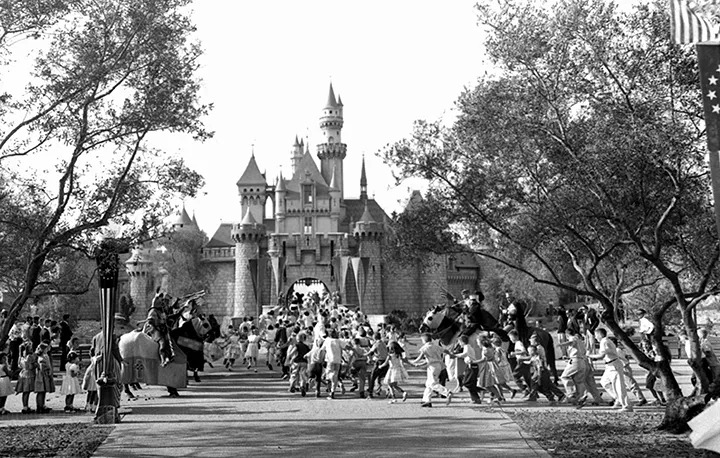
It was nearly 100 degrees. Traffic stood still for seven miles. The day was meant for invited guests and the press. Some 28,000 people came, and roughly half held counterfeit tickets or had climbed the fence (Wikipedia). Women's heels sank into asphalt poured too recently. The food ran out. A gas leak closed part of Fantasyland for a while, and a power overload stopped Mr. Toad (PBS). ABC carried it all live, with Art Linkletter, Bob Cummings and Ronald Reagan as hosts and guests tripping over the camera cables. Employees came to call it Black Sunday.
Walt read his dedication in Town Square. It began: "To all who come to this happy place: Welcome" (Wikipedia). The public came the next morning, Monday, July 18, to 20 attractions. Walt and Roy always counted the 18th as opening day. The company now celebrates the 17th. In the first year, about 3.6 million people came.
Quote watch. The most-quoted Walt line about the park says Disneyland will never be completed as long as there is imagination left in the world. Disney uses it often. It is not in the recorded dedication speech, and its wording shifts from one telling to the next. One early print appearance, a Chicago Tribune feature of March 31, 1968, places it at the dedication (DIX index of the article). This guide treats it as a real Walt sentiment with no fixed original wording.
Fun facts: the dream
- The Burbank lot first proposed for Mickey Mouse Park is now home to Walt Disney Animation Studios and ABC Studios (Wikipedia).
- Buzz Price went on to do more than 150 studies for Disney, including picking the site for Walt Disney World in 1963. Walt encouraged him to start his own firm, Economics Research Associates, in 1958 (D23).
- Herb Ryman was not a Disney employee when he drew Disneyland over that weekend in 1953. He was hired soon after and went on to render Sleeping Beauty Castle and New Orleans Square (Yesterland).
- The caption on Ryman's drawing described about 45 acres inside the railroad tracks.
- Walt sketched the railroad's triangular route onto the Anaheim site plan himself, on August 8, 1953 (Wikipedia: Disneyland Railroad).
- Man in Space, a first-season Tomorrowland episode of the Disneyland TV series, was later edited for theaters and nominated for an Academy Award (Walt Disney Family Museum).
- Walt had the Disneyland series filmed in color even though most of the audience watched in black and white. When NBC launched Walt Disney's Wonderful World of Color in 1961, the old episodes could be rerun in color.
- Walt could not afford to build a hotel, so his friend, the producer Jack Wrather, built the Disneyland Hotel across the street. It opened three months after the park (Wikipedia: Disneyland Resort).
- Unlike many amusement parks of its day, Disneyland was never racially segregated. It was open to everyone from opening day (Wikipedia).
- On opening day, adult admission was $1 and children's was 50 cents. Each ride cost extra, from 10 to 35 cents (Wikipedia: Disneyland Resort).
Where the story goes next
Begin
- Timelineseventy-one years of openings, closings and crowds
The lands
- Main Street, U.S.A.the first land every guest walks through
- Adventurelandone river in 1955, then birds, a treehouse and a temple
- Frontierlandthe stockade, the island, the saloon and the mountain
- Fantasylandthe castle, the storybook rides, the Matterhorn and a small world
- Tomorrowlandseventy years of futures, and the next one announced
- New Orleans SquareWalt's last land, the pirates, the ghosts and Club 33
- Bayou Countrysinging bears, a log flume and four names in fifty years
- Mickey's Toontowna cartoon town on old backstage land, rebuilt for small children in 2023
- Galaxy's Edgefourteen acres of Batuu
Across the park
- The Trainsevery train in the park, from Walt's backyard to the Monorail
- The Boatsevery boat on the river, the lagoon and the canals
- Lost and Never-BuiltHolidayland, Liberty Street, Discovery Bay, Port Disney and WestCOT
- People of Disneylandthe artists, Imagineers and builders behind the park, and every name on the Main Street windows
Reference
- By the Numbersattendance, crowds by month, hours, weather, breakdowns and the expansion ahead
- Hidden History & Park Culturethe petrified tree, ticket books, Star Wars before Batuu, characters, parking and the people who stayed
- Birding at Disneylandthe wild birds that live in a theme park
- Planning Your Visitgetting there, rope drop, food, deals, free things and quiet corners
- Sourceswhere every fact comes from, plus picture credits
More chapters are in progress: parades and fireworks, cast-member traditions, and the Imagineers, animators and voice artists behind the park.